Purplefish AI Visibility Tool: Methodology
Overview
The AI Visibility Score is a composite indicator (0–100) that measures how visible, discoverable and citable a brand is across AI-powered platforms — including ChatGPT, Google Gemini, Claude, Perplexity and Microsoft Copilot.
These platforms are increasingly the first point of discovery for B2B and B2C buyers, and unlike traditional search engines, they do not return a list of links, they select and recommend specific brands by name.
By 2026, Retrieval Augmented Generation (RAG) has become the standard architecture for all major AI platforms. This means AI systems now combine their base training knowledge with real-time web retrieval when generating answers.
“As a result, a brand's current web presence, technical accessibility and content freshness matter as much as its historical brand authority.”
Research by 5W Public Relations, citing Brandlight analysis (May 2026), found that the overlap between top Google ranking pages and sources cited inside AI-generated answers had collapsed from approximately 70% to under 20% across major AI platforms.
A parallel study by Ahrefs found the overlap for Google AI Overviews specifically had fallen from 76% to 38% in under 12 months, with BrightEdge reporting an even lower figure of approximately 17%. The pace of change is significant: in roughly 18 months, the relationship between Google ranking and AI citation has gone from broadly correlated to largely disconnected.
A brand ranking number one on Google can no longer assume it will appear in ChatGPT, Gemini, Claude or Perplexity responses for the same query.
Sources: 5W Public Relations / Brandlight, AI Platform Citation Source Index, May 2026 (prnewswire.com); Ahrefs, AI Search Overlap Study, 2026 (ahrefs.com/blog/ai-search-overlap); BrightEdge, February 2026.
The Purplefish AI Visibility Tool©
The tool produces a score using a combination of live automated checks (where data can be retrieved directly) and AI-assisted inference (where live data is not available). This document explains both and is explicit about which is which.
Data Sources: What Is Live Data and What Is Inference
This is one of the most important things to understand about how the score is calculated. The tool uses two distinct types of data:
Live automated checks (real data)
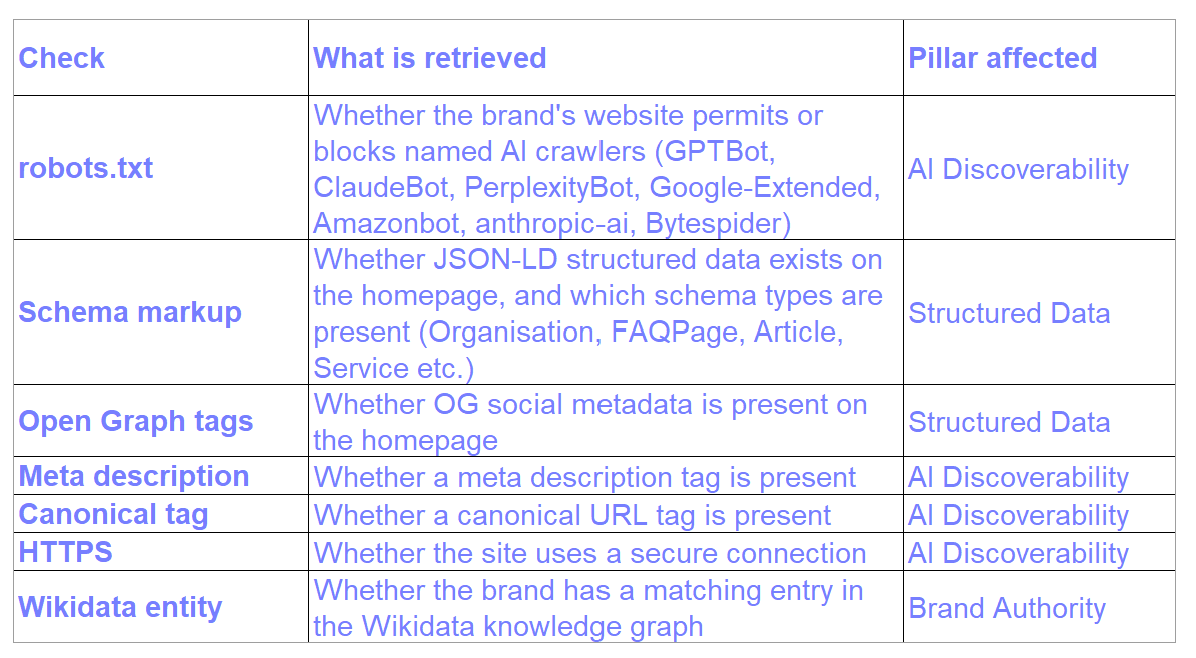
The following are checked automatically in real time by querying the brand's website and public databases directly. These are factual, not estimated:
AI-assisted inference (estimated signals)
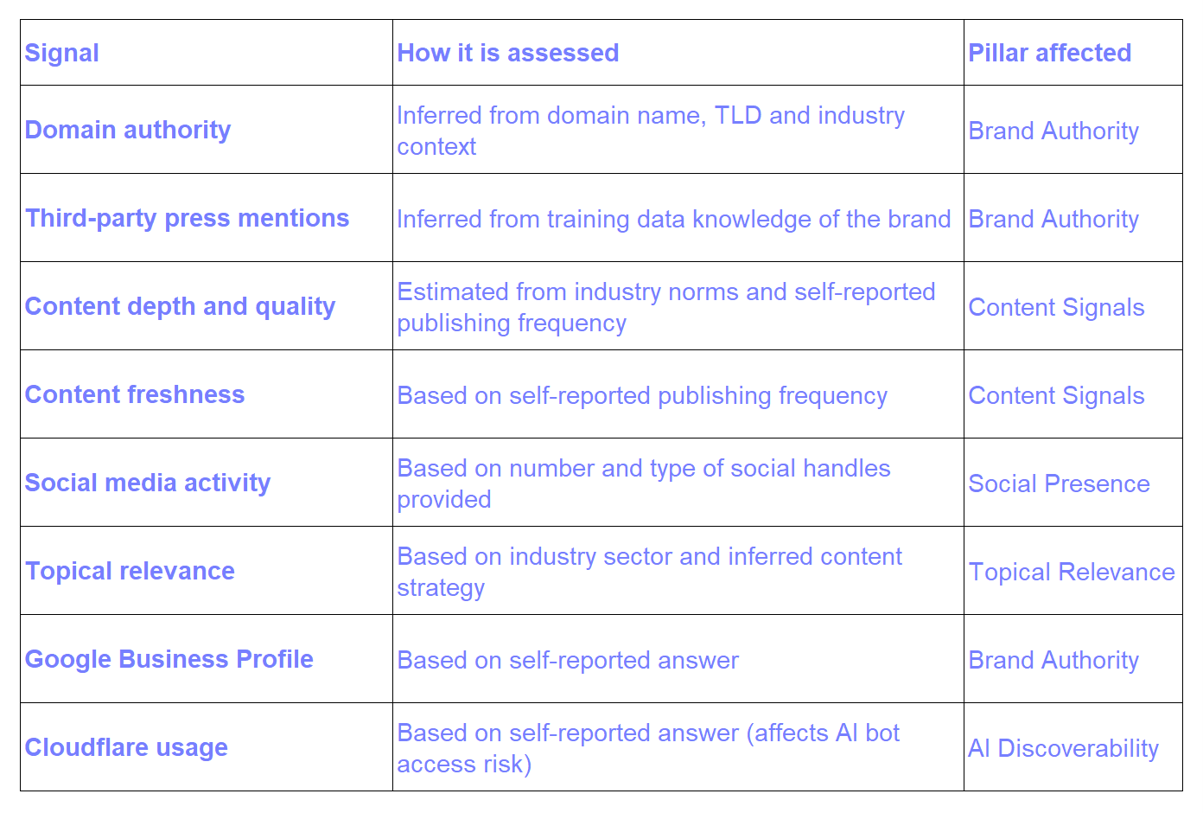
The following are assessed by the AI model based on its training data, the information provided in the form and established patterns for brands in the relevant sector. These are informed estimates, not live measurements:
For well-known brands, the AI model's training data provides reasonably accurate inference. For newer or less well-known brands, inference is based primarily on the domain, industry and form responses and therefore should be treated as directional rather than precise.
The Six Pillars
1. Brand Authority [weighting: 25%]
What it measures: How well-established, widely referenced and recognisable a brand is across the open web, the primary source material from which large language models learn about the world.
What is evaluated:
Domain age and perceived authority. Established domains score higher than newly registered ones
Volume and quality of third-party mentions: press coverage, directory listings, industry publications, review platforms, awards
Wikipedia and Wikidata presence: having a Wikipedia page or Wikidata entity entry is one of the single strongest brand authority signals for AI systems. Knowledge graph entries are used by AI platforms to verify that a brand is a real, established entity worth citing. Brands without any knowledge graph presence are significantly less likely to be recommended by AI. A confirmed Wikidata entry adds approximately 10–15 points to this pillar score
Google Business Profile: a verified Google Business Profile confirms a brand's existence, location and contact details to Google's AI systems and others that draw on Google's knowledge graph. A confirmed profile adds approximately 5–8 points to this pillar score
Whether the brand name is distinctive and unambiguous. Generic names score lower because AI systems cannot confidently attribute content to the specific entity
Evidence of named leadership or spokespeople who themselves carry authority signals
Sector-specific authority markers: trade body membership, industry awards, regulatory body listings
Data source: Wikidata check is live automated data. All other signals are AI-assisted inference.
Scoring range:
75–100 = Strong, established brand with significant third-party validation, knowledge graph presence and press history
50–74 = Recognised brand with moderate third-party presence; some knowledge graph signals
25–49 = Limited third-party validation; newer brand or limited press history
0–24 = Minimal web presence; no knowledge graph entry; very limited citations
2. Content Signals [weighting: 20%]
What it measures: The quality, depth, format and freshness of content on the brand's own website, specifically how useful that content is as source material for AI systems to extract, reference and cite.
What is evaluated:
Whether the website contains substantive long-form content (articles, guides, case studies, white papers) beyond basic service or product pages
Whether content is structured with clear headings, logical hierarchy and scannable formatting, the formats AI systems can most easily parse and attribute
Whether content addresses the specific questions a user might ask an AI platform (informational intent, not just commercial)
Content freshness: in 2026 AI systems have a strong recency bias. Content older than approximately 3 months sees sharply reduced citation rates as AI platforms prioritise recently crawled material. Brands publishing weekly or monthly score significantly higher than those publishing rarely. This signal is based on the self-reported publishing frequency provided in the form
Whether the brand publishes a dedicated resource hub, blog or thought leadership section
Content depth per page: thin content (under 300 words) scores poorly; comprehensive pillar content (1,000+ words with structured headings) scores well
Whether content demonstrates first-hand expertise, original research or proprietary insight, the signals AI systems use to assess citation-worthiness
Data source: All signals are AI-assisted inference, informed by the self-reported content publishing frequency.
Scoring range:
75–100 = Rich, regularly updated content hub with long-form, question-answering articles published at least monthly
50–74 = Good content base with some depth; publishing cadence could be more consistent
25–49 = Primarily service pages with limited editorial content; publishing infrequent
0–24 = Minimal content beyond homepage and contact page; rarely or never publishes new material
3. AI Discoverability [weighting: 25%]
What it measures: The technical signals that determine whether AI platforms can find, access, parse and cite the brand's web content. This pillar is particularly significant because many brands are inadvertently blocking AI crawlers without realising it.
What is evaluated:
robots.txt — AI crawler access(live data): The robots.txt file tells web crawlers which parts of a site they are permitted to access. AI platforms each send their own named crawler (GPTBot for ChatGPT, ClaudeBot for Claude, PerplexityBot for Perplexity, Google-Extended for Gemini). If any of these are blocked in the robots.txt file, that AI platform cannot crawl or index the brand's content, meaning it is effectively invisible to that platform regardless of how good the content is. This is checked live against the brand's actual robots.txt file
Cloudflare and AI bot blocking(self-reported): Cloudflare, the widely used web security and performance service, changed its default configuration in 2024–2025 to block AI crawlers as standard. Many website owners are unaware this has happened. If a brand confirms it uses Cloudflare, this is flagged as a significant risk requiring investigation, as AI crawlers may have been blocked at the network level even if the robots.txt permits them
Sitemap(live data): Whether a sitemap is declared in the robots.txt helps AI crawlers navigate the site efficiently
HTTPS(live data): A secure connection is a basic trust signal for AI systems
Meta description(live data): Accurate meta descriptions help AI systems understand and summarise page content
Canonical tag(live data): Canonical tags prevent AI systems from indexing duplicate content
Presence of a clear, machine-readable About page - helps AI systems understand the brand's identity and purpose
Mobile responsiveness and page speed - slow or broken pages are less likely to be successfully crawled
Data source: robots.txt, sitemap, HTTPS, meta description and canonical tag are live automated data. Cloudflare risk is self-reported. Page speed and About page are AI-assisted inference.
Scoring range:
75–100 = All major AI crawlers permitted; sitemap declared; HTTPS; clean technical setup
50–74 = Most AI crawlers permitted; minor technical gaps
25–49 = Some AI crawlers blocked or Cloudflare risk identified; technical issues present
0–24 = Multiple major AI crawlers blocked; significant technical barriers to discoverability
4. Social Presence [weighting: 10%]
What it measures: The brand's consistency, activity and reach across social media channels is a secondary signal that AI systems use to validate brand credibility and current relevance.
What is evaluated:
Whether the brand has active accounts on the platforms most relevant to its sector e.g.LinkedIn for B2B brands; Instagram and X/Twitter for consumer brands; presence across multiple platforms signals broader reach
LinkedIn is weighted most heavily for B2B brands, it is the platform most likely to influence AI systems assessing professional services and agency credibility. Company page completeness, posting frequency and employee advocacy all contribute
Instagram signals consumer brand presence and visual content production capacity
X/Twitter signals real-time commentary, media engagement and thought leadership
Consistency of brand name, messaging and visual identity across platforms
Posting frequency: brands that publish substantive content regularly signal they are active and current
Third-party mentions and tags: unlinked brand mentions across social platforms carry weight with AI systems assessing brand reach
Data source: Social presence is assessed based on the handles provided in the form. The tool does not access live follower counts, engagement rates or posting frequency, these are inferred from the platforms provided and industry norms. Providing no handles results in a lower Social Presence score (20–35 range).
Scoring range:
65–100 = Active across 3+ relevant platforms; consistent posting and strong LinkedIn presence
45–64 = Active on 1–2 platforms with reasonable posting cadence
20–44 = Limited or inconsistent social presence; single platform or dormant accounts
0–19 = No social handles provided or confirmed absent
5. Structured Data [weighting: 10%]
What it measures: The presence and quality of machine-readable markup on the brand's website — code that tells AI systems explicitly what a page is about, rather than requiring them to interpret unstructured prose.
What is evaluated:
JSON-LD schema types(live data from homepage check):
Organisation / Local business confirms the entity's identity, location, contact details and services
FAQ page: the single schema type most likely to result in direct AI-generated answer surfacing; FAQ schema content is frequently extracted verbatim by AI platforms to answer user questions
Article / blog posting: identifies content as citable editorial material rather than marketing copy
Service: defines what the brand offers in a structured, parseable format
BreadcrumbList: helps AI systems understand site structure and page hierarchy
Person: attributes content to named individuals, supporting thought leadership citation
Open Graph tags(live data): Metadata used by AI systems (and social platforms) to understand the title, description and image associated with each page
Meta description(live data): Used by AI systems to understand and summarise page content in generated answers
Whether product or service pages carry additional relevant schema (pricing, reviews, availability)
Absence of conflicting or malformed schema that could confuse crawlers
Data source: JSON-LD schema, Open Graph tags and meta description are all live automated data checked against the brand's actual homepage. This is one of the most factually accurate pillars in the assessment.
Scoring range:
75–100 = Multiple high-value schema types implemented; OG tags complete; clean structured data
50–74 = Some schema present but incomplete; missing high-value types like FAQPage
20–49 = Minimal schema: perhaps only Organisation or basic OG tags
0–19 = No JSON-LD schema detected on homepage
6. Topical Relevance [weighting: 10%]
What it measures: How closely and comprehensively the brand's content maps to the specific questions and topics its target audience is likely to ask AI platforms and whether the brand is the kind of authoritative source an AI would cite in response.
What is evaluated:
Whether content covers the full range of questions a prospective customer in this sector would ask an AI, not just commercial pages ("our services") but genuinely informational content ("how do I choose a PR agency for a tech startup?")
Whether the brand uses the specific terminology, phrases and entity names that define its sector, AI systems match content to queries using semantic proximity, so precision of language matters
Whether the brand has published content around emerging topics in its sector, recency of topical coverage signals active expertise
Whether the brand's content demonstrates a coherent, focused area of expertise rather than broad, shallow coverage of many topics
Whether the brand is associated with specific named methodologies, frameworks or sub-topics that users might search for by name via AI
Data source: These signals are AI-assisted inference based on the brand's industry, domain and inferred content strategy.
Scoring range:
70–100 = Content directly and comprehensively addresses questions users ask AI; strong topical authority
45–69 = Reasonable topical coverage with some gaps; content not fully optimised for AI query formats
20–44 = Generic or inward-facing content; limited coverage of the questions buyers ask AI platforms
0–19 = Content does not address informational queries; unlikely to be cited by AI for any sector queries
Overall Score Calculation
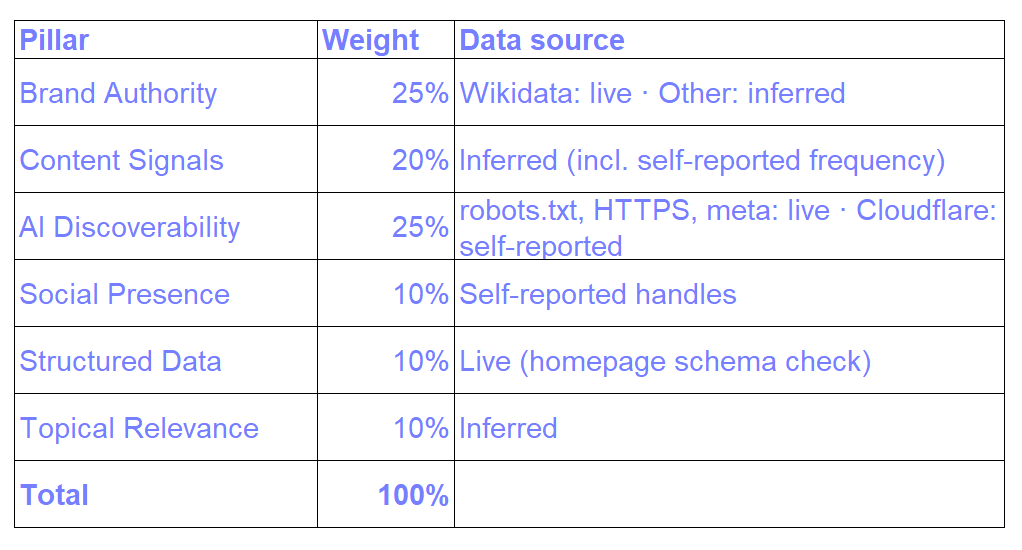
The AI Visibility Score is a weighted average of the six pillar scores:
Formula: Score = (Brand Authority × 0.25) + (Content Signals × 0.20) + (AI Discoverability × 0.25) + (Social Presence × 0.10) + (Structured Data × 0.10) + (Topical Relevance × 0.10)
Brand Authority and AI Discoverability carry the highest combined weight (50%) because these are the two factors most directly correlated with whether an AI platform will select and cite a brand in response to a relevant query.
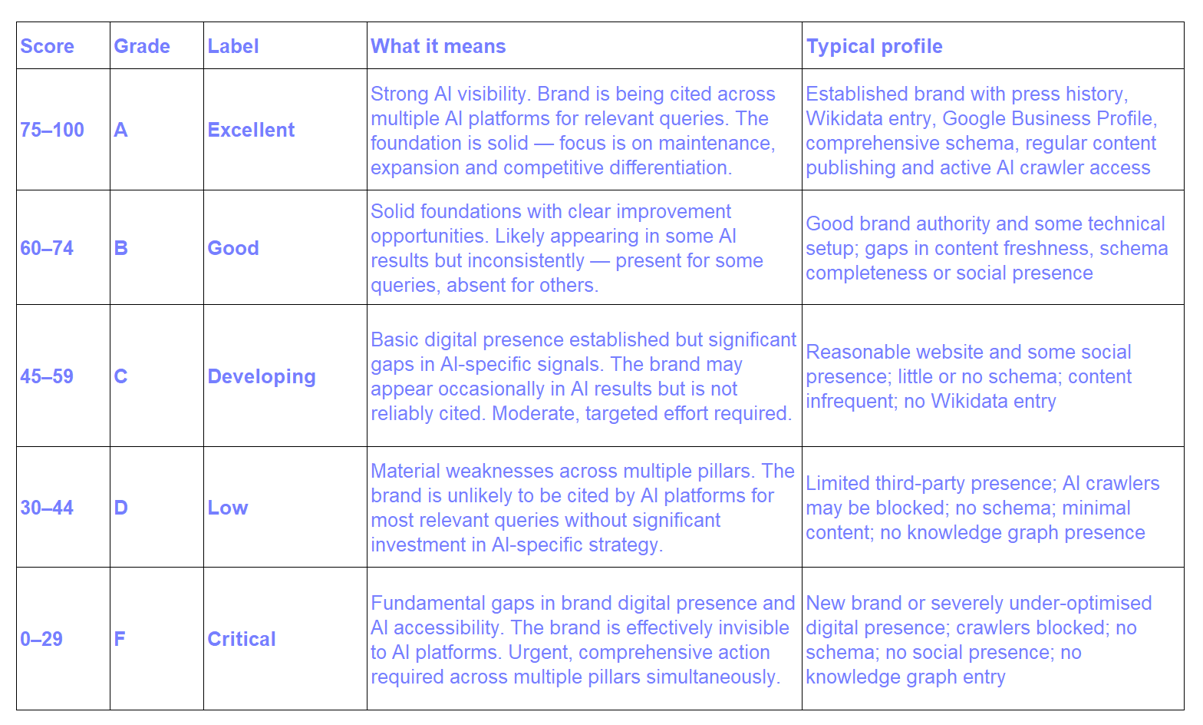
Grade thresholds and scoring matrix
Opportunity Classification
In addition to the grade, each audit result is tagged with an opportunity classification:
High opportunity
0–39 = Significant room for improvement; AI strategy investment will deliver measurable visibility gains
Medium opportunity
40–64 = Targeted improvements to specific pillars will increase citation rates meaningfully
Strong base
65–100 = Solid foundation; focus on maintaining advantage and deepening topical authority
Special signals explained
Why Cloudflare matters
Cloudflare is a widely used web security, performance and CDN (Content Delivery Network) service used by millions of websites globally. In 2024–2025, Cloudflare changed its default configuration to block AI crawlers this included GPTBot (ChatGPT), ClaudeBot (Claude) and PerplexityBot (Perplexity) as standard for all customers.
Cloudflare's rationale is that AI companies were using large-scale crawling to harvest website content for model training without the website owner's consent or compensation. By blocking AI bots by default, Cloudflare positioned itself as protecting website owners' intellectual property.
The practical consequence for brands is significant: if a website uses Cloudflare and the AI bot block has not been manually disabled, the website may be completely invisible to one or more major AI platforms, regardless of how good the content is, how comprehensive the schema is, or how strong the brand authority. The block operates at the network level, before crawlers can even reach the website.
Brands that confirm they use Cloudflare are flagged for this risk and advised to check their Cloudflare settings under Security → Bots → Bot Fight Mode and their robots.txt to ensure AI crawlers are explicitly permitted.
Why Wikidata matters
Wikidata is a free, open knowledge graph maintained by the Wikimedia Foundation, the same organisation that runs Wikipedia. It is a structured database of entities (people, organisations, places, concepts) and their relationships, and it underpins a significant proportion of what AI systems "know" about the world.
Major AI platforms including Google's Gemini, ChatGPT and Perplexity all draw on Wikidata and Wikipedia data both in their training corpora and in real-time retrieval. A brand with a Wikidata entity entry has a structured, machine-readable identity that AI systems can reliably recognise, verify and cite. A brand without one is relying entirely on the AI inferring its identity from unstructured web content, a much weaker signal.
Having a Wikidata entry does not require a Wikipedia article (though a Wikipedia article will automatically generate one). Brands can create a Wikidata entry directly at wikidata.org, providing key facts such as the organisation's founding date, location, industry, website and key personnel. This is one of the highest-impact, lowest-cost improvements a brand can make to its AI visibility.
Why a Google Business Profile matters
A verified Google Business Profile confirms a brand's existence, trading name, location, contact details and business category to Google's systems, including Gemini, which draws directly on Google's knowledge graph. It also signals to other AI platforms that index Google data that the brand is a legitimate, trading entity with a verified physical or operational presence. For any brand that serves clients in a specific location or sector, a complete and verified Google Business Profile is a foundational AI visibility signal.
Methodology notes and limitations
Live data accuracy: The robots.txt, schema, Open Graph, HTTPS, canonical tag and Wikidata checks reflect the state of those signals at the exact moment the audit is run. They are accurate point-in-time measurements. Changes made to the website after the audit (such as adding schema or updating robots.txt) will not be reflected until the audit is re-run.
Inference accuracy: Signals assessed by AI inference, particularly content depth, topical relevance and brand authority for less well-known brands, are directional estimates. For well-known brands with significant web presence, the AI model's training data provides a reasonably accurate basis for inference. For newer or less well-known brands, inference is primarily based on the domain, industry and form responses and should be treated as indicative.
Self-reported accuracy: Content publishing frequency, Google Business Profile status and Cloudflare usage are self-reported. The scores derived from these signals are only as accurate as the information provided.
Point-in-time assessment: The score reflects the brand's AI visibility at the time of the audit. The AI landscape is evolving rapidly, platforms change how they rank and cite sources regularly. Scores should be re-run every three to six months to track progress and respond to platform changes.
Industry calibration: Scores are assessed relative to typical performance in the brand's stated sector. Competition levels vary significantly — a score of 55 in financial services or technology may represent stronger relative performance than 55 in a less contested sector.
Score variance: Because part of the evaluation is AI-generated, identical inputs run at different times may produce slightly different scores (typically ±5 points). This is inherent to probabilistic language model outputs and does not indicate an error. The live data checks (robots.txt, schema, Wikidata) produce consistent results regardless of when they are run.
Not a substitute for full technical audit: This tool provides a rapid, indicative assessment. It does not run PageSpeed tests, audit all pages on the site, check server response codes, or test mobile rendering. For a comprehensive technical AI optimisation audit, contact Purplefish.
Purplefish Agency · purplefish.agency · AI Visibility Tool© Methodology v2.0 · September 2026