
AIO vs. GEO and the rising role of PR

We had just about mastered what we needed to do in the world of SEO over the last few years and now it’s all being shaken up in this AI era.
The rules are changing again. Here’s our plain English guide to what you need to know right now to stand out from the crowd.
If you’ve spent any time in marketing or communications circles lately, you’ve probably started hearing two new terms thrown around: AIO and GEO. Sometimes interchangeably, sometimes as opposites, often without much clarity about what either actually means.
Of course, both relate to AI. Both are about visibility. And both matter enormously for any brand that cares about being found, trusted and recommended in a world where Large Language Models (LLMs) are becoming the primary way people discover information.
The first point to note is that they are not the same, here’s the skinny on what’s going on in this space:
First, for context: AI has already changed ‘search’
Not long ago, search was simple in concept. You typed a query into Google (other search engines are available), got a list of links, and decided which one to click (most likely the one of the top three and definitely on the first page). SEO (Search Engine Optimisation) was the discipline of making sure your site appeared as near as possible to the top of that list.
That model is changing fast. AI-powered tools like ChatGPT, Claude, Perplexity and Google’s Gemini are generating direct answers to questions rather than serving up links. Instead of showing you ten blue links, they tell you the answer. Your brand either features in that answer, or it doesn’t.
This shift in search has given rise to two new disciplines: GEO and AIO.
What is GEO?
GEO stands for Generative Engine Optimisation. It emerged from the SEO world and is focused on a specific technical challenge: how do you structure and present your content so that generative AI engines like ChatGPT et al are more likely to surface it in their answers?
Think of GEO as the next evolution of SEO. It borrows many of the same SEO principles e.g. clear structure, authoritative content, good metadata, strong backlinks etc. but applies them with generative AI systems in mind.
The question you now need to answer is: when an AI engine is scanning the web to answer a question, does it find your content, understand it and, crucially, choose to show it to the user?
“GEO asks: how do we make our content easy for AI to find and use? AIO asks: how do we make our brand worth talking about in the first place?”
What is AIO?
AIO stands for AI Optimisation. It operates at a different level to GEO. Where GEO is primarily a content and technical discipline, AIO is fundamentally a reputation discipline. This is where traditionally the art of PR starts to have influence.
AIO is the practice of ensuring your brand is positively, accurately and consistently represented across AI systems when they are forming an ‘answer’ to a question posed by a user. Therefore, AIO results unlike SEO and GEO, do not just offer a website as a result. AIO results will evaluate and show earned results – think news coverage, third-party mentions, reviews, industry reports, social profiles and more. It’s the stuff I‘m afraid you have less control over, but which has always been known to have more value.
Remember this?:
”Advertising is what you pay to tell people about yourself; PR is what other people say about you.”
In a similar vein, this explanation of the difference between PR and advertising is a good starting point in understanding the difference between GEO and AIO. The key takeaway is that earning trust and credibility is more important than ever. Read our recent article on How to build trust in the age of information overload
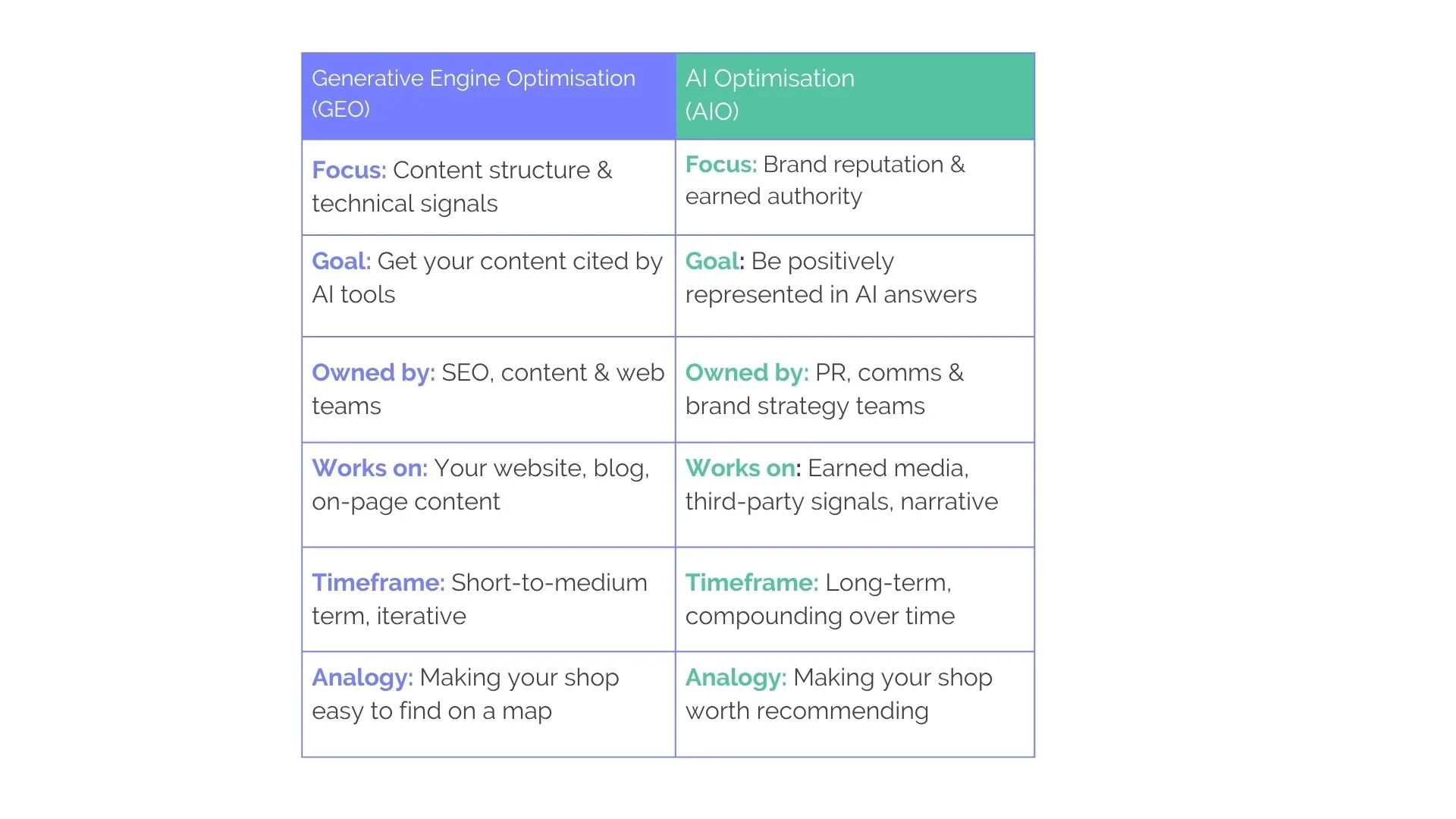
Side by side: how they compare
See the differences between GEO and AIO at-a-glance
Treating GEO and AIO as the same thing is not the way to go. Brands invest heavily in technical content optimisation and assume that’s enough. It isn’t.
The reason for this is that AI systems don’t just look at your website, they weight content from across the internet, with earned, third-party sources often carrying more authority than owned content. A well-structured product page is useful. But coverage in a respected industry publication, an executive quoted in the national press, or a consistent pattern of positive reviews across multiple platforms — these are the signals that build genuine AI authority.
Conversely, a brand with excellent PR but a poorly structured website may earn positive AI mentions but struggle to get its specific content surfaced. Both matter. They just require different skills and different teams. But collaborative working and a holistic, strategically driven approach in the planning.
Where they overlap
The most effective approach combines both. A thought leadership article that earns coverage in a trade publication (AIO) and is also well-structured, clearly attributed and linked to credible sources (GEO) is doing double duty. The results will be to build your AI reputation while also making your content more likely to be directly cited.
The role of PR in an AIO and GEO world
If GEO sits naturally with SEO and content teams, AIO sits squarely in the domain of PR and communications. And in many ways, AIO simply makes the value of good PR more measurable and more urgent.
The inputs that drive AIO success are exactly what PR has always delivered. Make no mistake anyone that tells you that PR can’t be measured is probably spouting from the 1997 PR playbook.
It’s not new, but it is more powerful than ever before. Here are the PR activities to focus on:
• Earned coverage in credible, high-authority media outlets
• Thought leadership content placed in respected third-party publications
• Consistent, clear messaging that tells a coherent story about who you are
• Executive visibility in the form of well-trained spokespeople who are recognised and quoted externally (and who have a strong LinkedIn presence)
A practical starting point
If you’re not sure where to begin, a useful exercise is to test how you currently show up. Ask a few AI tools (the aforementioned ChatGPT, Perplexity, Claude, Google’s AI Overview) questions that a potential customer might ask about your industry or sector. Do you appear? In what context? Are the details accurate? Is the characterisation of your brand positive?
What you find will tell you a lot about where to focus effort. Gaps in GEO tend to show up as missing from answers entirely, even when you’d expect to feature. Gaps in AIO tend to show up as appearing in a vague, generic, or less favourable light than competitors with stronger earned reputations.
A GEO gap looks like: Not appearing at all
An AIO gap looks like: Appearing but vaguely and non-specific
Both working looks like: Featured and trusted
The bottom line
GEO and AIO are complementary, not competing. GEO ensures AI tools can find and use your content. AIO ensures that when they do, your brand is represented with authority, accuracy, trust and credibility.
Brands that understand the distinction and invest in both will be significantly better positioned as AI continues to reshape how people discover, evaluate and choose the businesses they work with and the products and services they buy.
The good news? If you’ve been investing in quality PR and communications for years, you already have a head start on AIO. The public record you’ve been building is exactly what the AI era rewards.
At Purplefish, we help technology, property, and purpose-led businesses build the kind of credible, consistent reputation that performs in a world shaped by AI. If you’d like to understand how your brand currently shows up — and how to strengthen it — we’d love to talk.
